|
Travel Writing by Robert Louis Stevenson
|
Read the Virtual Book
Summary
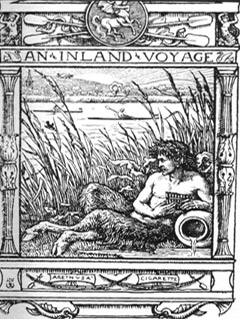
An Inland Voyage recounts a canoe trip Stevenson and his friend Sir Walter Grindlay Simpson made in 1876. Setting out from Antwerp, Stevenson (in the Arethusa) and Simpson (in the Cigarette) paddled through Belgium and France along canals and the Oise River.
Much of the travelogue relates adventures the two men had along the way. Some of the more notable incidents include the travellers’ inability to use an Etna stove, watching a marionette show, and “being continually wetted with rain” (p. 91). At one point, Stevenson was left clinging to a tree after his canoe was swept away.Stevenson also describes many of the interesting people he and Simpson met. These included members of the Royal Sport Nautique and a family that lived on a barge.
Thoughts on wider issues – such as the French character and politics, religion, and the artist’s role in society – also feature.
The text includes, too, several philosophic moments, such as the following:
|
|
Read more...
|
|
|
Edinburgh: Picturesque Notes, 1878 |
|
Read the Virtual Book
Summary
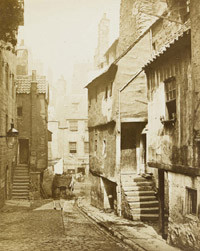
Edinburgh: Picturesque Notes is a series of essays describing different areas of Edinburgh: the Old Town, the Parliament Close, Greyfriar’s Kirkyard, the New Town, the villas in Morningside, Calton Hill and the Pentlands.
Stevenson discusses how Edinburgh is a doubled city of contrasts often placed one beside another. The city is split between the old and the new, the rich and the poor, and the city and the country.
In some passages he idealizes the city’s beauty with a nostalgic longing for the past. In others, particularly the chapter on "Legends", he highlights Edinburgh’s darker, more gruesome history. For example, he refers to Deacon Brodie, Major Weir and the plague.
|
|
Read more...
|
|
Travels with a Donkey in the Cevennes, 1879 |
|
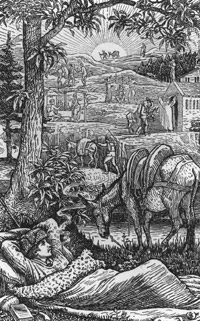
Read the Virtual Book Summary Travels with a Donkey describes Stevenson’s hiking trip in the Cevennes, in South-Central France.
The narrative largely focuses on Stevenson’s humorous descriptions of his stubborn travel companion, Modestine the donkey. Stevenson bought Modestine to carry his belongings for the journey. However, Modestine walks so slowly that Stevenson is
“kept [. . . ] hanging on each foot for an incredible length of time; in five minutes it exhausted the spirit and set up a fever in all the muscles of the leg. And yet I had to keep close at hand and measure my advance exactly upon hers; for if I dropped a few yards into the rear, or went a few yards ahead, Modestine came instantly to a halt and began to browse” (pp. 149-50).
As in An Inland Voyage, Stevenson is mistaken several times for a pedlar. During his travels he often sleeps under the stars, in a special sleeping-sack made for him in Le Puy.
|
|
Read more...
|
|
The Silverado Squatters, 1884 |
|
Read the Virtual Book
Summary
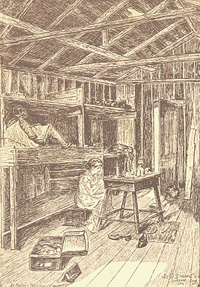
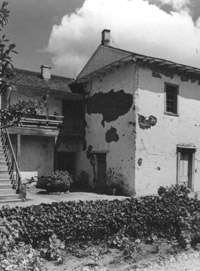
On 22 May 1880, RLS and Fanny Stevenson left for their honeymoon in the Napa Valley region of California (accompanied by Fanny’s son Lloyd Osbourne). Stevenson later described their travels in Silverado Squatters.
In Calistoga RLS uses a telephone for the first time. He also visits a petrified forest and samples Napa Valley wine. In his travels through the region, RLS meets a variety of interesting characters: other Scots abroad, for example, and Mr Kelmar who is wholly preoccupied with making money.
In Silverado Squatters RLS returns again and again to themes of national identity – he is preoccupied by what it means to his sense of self to leave his homeland behind: “I wrote that a man belonged in these days to a variety of countries; but the old land is still the true love, the others are but pleasant infidelities. Scotland is indefinable; it has no unity except upon the map” (p. 194). Indeed, despite finding California beautiful, RLS is often deeply nostalgic for Scotland and in particular, Edinburgh: “there are no stars as lovely as Edinburgh streetlamps. When I forget thee, auld Reekie, may my right hand forget its cunning” (p. 195).
|
|
Read more...
|
|
Across the Plains with Other Memories and Essays, 1892 |
|
Read the Virtual Book
Across the Plains Contents
"Across the Plains: Leaves from the Notebook of an Emigrant between New York and San Francisco" (1883) "The Old Pacific Capital" (1880) "Fontainebleau" (1884) "Epilogue to An Inland Voyage" (1888) "Contributions to the History of Fife: Random Memories" (1888) "The Education of an Engineer: More Random Memories" (1888) "The Lantern Bearers" (1888) "A Chapter on Dreams" (1888) "Beggars" (1888) "A Letter to a Young Gentleman who Proposes to Embrace the Career of Art" (1888) "Pulvis et Umbra" (1888) "A Christmas Sermon" (1888)
|
|
Read more...
|
|
The Amateur Emigrant, 1895 |
|
Read the Virtual Book
Summary
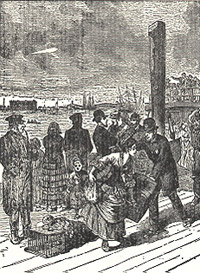
Stevenson’s journey to late nineteenth-century America was an immersion course in the privation and misery of emigrant steam and rail travel. It was a chastening corrective to Stevenson’s romantic view of the New World. “For many years,” Stevenson explains in The Amateur Emigrant, “American was to me a sort of promised land.”
America had, moreover, the added appeal of release from constraint and convention: “The war of life was still conducted in the open and on free barbaric terms" (p. 105). The emigrants he observed, however, were hardly brave seekers of the golden land of democracy and equality; they were largely life’s failures. “The more I saw of my fellow passengers,” writes Stevenson, the subdued enthusiast, “The less I was tempted to the lyric note” (p. 43).
Stevenson’s near-steerage accommodations on ship and the cramped, airless, and miserable circumstances of the emigrant train, affect not only his personal views but his writing: his experiences result in a sharpened prose style.
|
|
Read more...
|
|
Read the Virtual Book | View Images
Summary
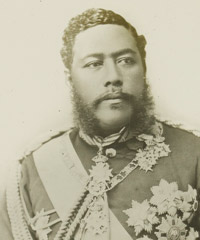
Towards the end of the Equator cruise, RLS started trying to put together the material he had collected about South Seas culture, language, traditions and society: anthropology, history, sociology together with personal impressions. He had already agreed with S. S. McClure (in 1888) to sell him “letters” from the South Seas to be syndicated in newspapers and magazines. These he hoped to use for materials for the “big book” on the Pacific.
The volume published as In the South Seas was edited by Sidney Colvin and published after RLS’s death in 1896.
RLS felt he had unique material: “such wild stories, such beautiful scenes, such singular intimacies, such manners and traditions, so incredible a mixture of the beautiful and horrible, the savage and civilised. [...] I propose to call the book The South Seas...”
|
|
Read more...
|
|
Read the Virtual Book
Note: The essays in this volume of travel writing were not included together by Stevenson. Nevertheless, Essays of Travel (London: Chatto and Windus, 1905) is included on the RLS Website because it contains some of the author’s travel essays that have not been collected together elsewhere. This volume will be particularly useful for those who wish to read more about travelling in Stevenson’s footsteps.
|
|
Read more...
|
|
|
|
|
|
|